
What is Spotifast?
Why Spotifast
Spotify, native and fast. Spotifast is a lightweight Spotify app for Linux, macOS, and Windows. It opens in well under a second and typically uses 100–250 MB of memory, while Spotify’s desktop app often uses 600 MB to over 1 GB.
Your Spotify playlists stay on your account.
Playback needs Spotify Premium. Free accounts can browse and search, but cannot play music through Spotifast on this computer or another device.
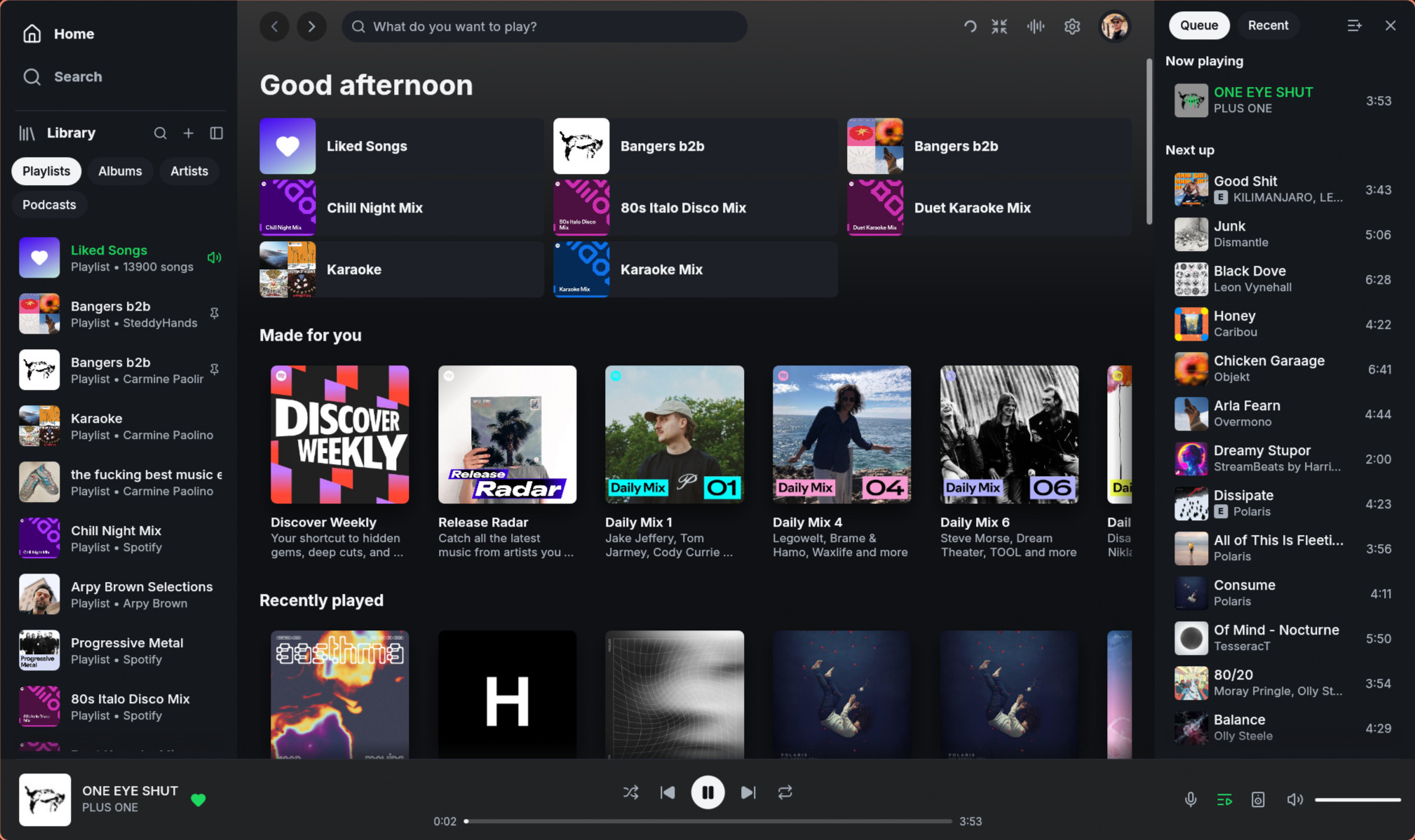
What it does
- Plays music on this computer. Spotifast appears as a Spotify Connect device. Select it from your phone or play music in the app. Playback has no added gaps between songs and supports up to 320 kbps. Optional settings keep songs at a similar loudness and reduce repeat downloads by keeping recently played audio.
- Controls other devices. Move playback to a speaker, a phone, or another computer from the device picker, and keep controlling it: play, pause, skip, seek, shuffle, repeat, volume. The picker expands upward to show several devices at once, fitting the window; longer lists scroll.
- Library. Browse playlists, Liked Songs, saved albums, followed artists, podcasts, and saved episodes. Create, edit, and reorder your playlists.
- Search across songs, artists, albums, playlists, podcasts, and episodes, with artist pages, discographies, and related artists. When Spotify provides an artist profile, select its name on a song, including the top result, to open that page.
- Background playback. Closing the window keeps the music playing from the system tray. Use your keyboard’s media keys to play, pause, and skip.
- Themes. Choose light, dark, or your own colours. On Omarchy, Spotifast can follow your desktop theme automatically. Pages can also take a colour from album art.
Is it safe for my Spotify account?
Soloist is Spotify’s official player for third-party apps, so with Soloist you’re listening the way Spotify provides for.
Spotifast never receives your Spotify password: you sign in on Spotify’s own website. It doesn’t unlock Premium, remove ads, export songs, or bypass Spotify’s copy protection.
The built-in player uses librespot and stays available. We know of no confirmed bans from normal Premium listening with it, though Spotify sometimes refuses it, which shows up as an audio key error.
What it does not do
Spotifast has a limited scope:
- Playing needs Spotify Premium, both on this computer and when controlling another device. Free accounts can browse and search.
- Built-in playback setup asks for two Spotify approvals: one to access your library, another to play music on this computer. How it connects explains why.
- The built-in player supports up to 320 kbps. librespot cannot play Spotify Lossless. Since 0.15, Spotifast also offers the optional Soloist player, which uses Spotify’s own implementation with lossless support. Soloist does not report the delivered audio format. Spotifast’s private audio routes provide EQ and visualizers on Linux and Mac, and visualizers on Windows.
- No video podcasts or social features.
- Changes at Spotify can briefly interrupt features until an update.
Bug reports should include spotifast.log, panic.log after a crash, and
steps to reproduce the problem. See the
issue form.
Development builds after 0.8.0 also record the app version, operating system,
and graphics details in the log. If the window fails to open, the log can
help explain why, even when you started the app from your desktop.
Prior art
Spotifast is written in Rust, with egui and fastframe for its interface and librespot for Spotify playback. fastframe is the shared foundation of a family of native apps, including Spotifast’s sibling ZapFast, a native client for WhatsApp. Spotifast takes inspiration from spotify-tui, spotify-player, ncspot, and Omarchy Spotify.
Spotifast is an independent project, not affiliated with or endorsed by Spotify AB. Spotify is a trademark of Spotify AB.